A Message from Pastor Craig: 10-4-2026

As Protestants, we are not sure about pilgrimages. I am one of the unsure. Growing up in Costa Rica, I saw tens of thousands of people taking a yearly pilgrimage from (at least) San Jose, where I lived, to a town called Cartago. I knew from history class that Cartago used to be the capital city of Costa Rica, and that the most famous church in Costa Rica was there, not because of the old capital city status, but because of a miracle that people claim happened there.

               The story goes that in 1635, yes, almost 300 years ago, a little girl of mixed race (and that part of the story is significant) found a little statue of the Virgin Mary holding her baby Jesus next to a spring in the woods. The girl took it home. The next morning, it was gone- it had found its way back to the spring. The girl took it back home again. The next morning, same thing, the statue was back at the spring. It happened three times. So, the adults decided a miracle had happened, built a little shrine, and people have been flocking to it ever since.

               If you go there, the site where the spring comes up is understood to be a source of holy water. If you go and see the statue, you see an enormous collection of little amulets of body parts. Bordering on the macabre, they are offerings commemorating healings from the holy water.

               I grew up taking people there, both as a kid with my parents, and later on as a guide. It was on the way to a volcano and made for a good stop along the way. My parents, and Protestants in general, panned the veracity of it all. The Rosario (as the pilgrimage is called) was viewed skeptically as a devotion to Mary (instead of Jesus) and the pursuit of superstition (that that water had magic powers.)

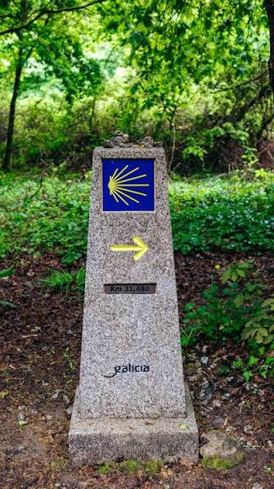
               And having said all that, today, after church, I am headed to the mother of all pilgrimages, the Camino de Santiago. (OK, it’s second to Jerusalem, but you don’t walk in Israel. You just go up and down the stairs of a bus.)  What’s up with that? What am I doing? I lend no credence that the bones of St. James can be found inside the cathedral there. And I don’t carry any expectation that arriving there for Mass will cure what ails me.

               For me, the walk is the pilgrimage. Maybe I’ve been influenced too much by John Bunyon. He wrote Pilgrim’s Progress. As he described the character Christian’s pilgrimage, that long walk was just life. Life is a long hike in which we aim for heaven. There are pitfalls all along the way. There are trials, temptations, and distractions. (The biggest concerns I carry in Spain are weather and my legs handling it.) Perseverance, as we see in the book of James, is a most valued lesson through all the trials of life. I covet your prayers.

I think we are all pilgrims. Not to Cartago, or Fatima, or Lourdes, or the Church of the Holy Sepulchre. No. To heaven. For some the walk is longer than it is for others. We miss those who have arrived before us. Some of us take more circuitous routes than others to get there. But all of us are on the Camino. Not to a little hamlet in Spain, but to a place where we delightfully meet our Maker.

So, grab your walking stick, put on your boots, and let’s go! The aid stations are many. You are in one this morning. The fellow pilgrims are many, too. The fact that the little statue of Mary appeared to a mixed-race girl in the jungle has meant, for Costa Ricans, that the miracles of God are for everybody, not just the elites (or the Spanish, specifically in those times.)  I like that. God’s grace is for every pilgrim.


Are you ready?

Craig

Consider it pure joy, my brothers, and sisters, whenever you face trials of many kinds, because you know that the testing of your faith produces perseverance. Let perseverance finish its work
so that you may be mature and complete, not lacking anything.
James 1:2-4 (NIV)

A Message from Pastor Craig: 9-27-2026

In a quest to find new places to walk, I tried out the paths at a park on the Western side of Bradenton (which is a town south of Tampa) called the Robinson Preserve. The Robinson family had farmland out there long before the snowbirds flocked to the area, and in the early 2000’s donated some 500 acres to Manatee County. It was abandoned farmland overtaken by invasive vegetation. The County turned its energy towards restoration of native wetlands, and today the mangroves, salt marshes and tidal creeks have gone crazy; there are mullet jumping in glee in each body of water I saw. The restoration success was remarkable.

               I’m writing this because there I saw the alternative to a rant I wrote a couple of months ago here about the welcome sign at another (much smaller) park up in Dania (where I walk as well). There, you may remember, a pole with a bunch of emblems greets the walker. It has a bunch of don’ts posted on it in the form of some figure with a crossed-out circle on it. No bikes, no walking off path, no drones, no taking things, no…. Just a bunch of don’ts. And even though all you’ve brought are tennis shoes and a hat, you almost feel like you shouldn’t be there. I complained that this can be the way people feel about Christianity generally, and about a local church in particular, when we’re all about the rules, and the rules focus on the negative.

               So, at the Robinson Preserve I didn’t see this collage of red, black, and white signs. Instead, the slender posts there comprised a stack of brown signs, little announcements of what you can do. A watchtower you can climb, a bicycle, a hiker, a fish and a hook, a picnic table, and a shelter. It also gave a mile marker number on it. This made for a much more welcoming sign. I wanted to climb the tower, walk the trails, see the water where maybe others fished.

               And as I walked, I thought that this too is a better way to think of our church, and of our faith. That the Bible is not a set of rules so much as a long list of things that you can do to enrich your life. That the church, this church, is a place where you can do a long list of things. This is a place where you can sing as much as you want. Pray as much as you want. Serve as much as you want. Visit with fellow pilgrims. Eat (often donuts in the morning, sometimes ice cream after church, or lunch on Saturdays, or a snack at MECE, or peppermints if you come to my office, the list goes on.)  You can learn the Scriptures, go to Sunday School in its different age iterations. Some people play instruments, some sing in a choir. The list here would fill a fence-worth of those poles in the public parks.

               I think Jesus intended this kind of thinking. When accused of breaking the law, He didn’t say that He came to abolish the law, but rather to fulfill it and focus on a better way. The better way was a liberating way of seeing the positive, of seeing how to not just avoid hurting others, but focusing on how to love them and make their lives better. To not just try to avoid angering God, but instead to develop a delightful relationship with Him. The paths in both parks that I’m comparing here were great, but the emphasis at each of the parks was quite different. One was clearly better, and I think illustrative of the way Christ would have us be as individuals, as churches, as a people called Christians. Let’s focus on what we can do, not what we can’t.

Learning to know God and love people,

Craig

But now, by dying to what once bound us, we have been released from the law so that we serve in the new way of the Spirit, and not in the old way of the written code. Romans 7:6 (NIV)

A Message from Pastor Craig: 9-20-2026

Last week I had to attend a meeting at a most unique site. I had been there many years ago as a tourist; now it served as a venue for a group of pastors to get together. Tucked away in what used to be Florida scrub and what is now a “Condo Canyon” is what they aptly call the Ancient Spanish Monastery.

Back in the 1950’s a remarkably wealthy and powerful man, who posthumously became famous because of his granddaughter’s kidnapping in 1974, bought a monastery in Spain. Only a fabulously wealthy person would think of dismantling, one stone block at a time, a cattle barn that had been at one time a Benedictine monastery.

And that’s what William Randolph Hearst did. But promptly after that, he had money troubles and never did anything about it. It sat in a million hay-filled crates (11,000 to be exact–I can’t imagine what that looked like) in Brooklyn for decades, until 1964, when two guys bought it and shipped it to North Maimi where it sits today.

Oh, the squirrels you could chase in this story!  Spanish history of the 12th Century. The oligarchical nature of the Hearst family. Patty Hearst and the Symbionese Liberation Army. Twentieth century tourism in Florida. The Episcopal Church (which now owns it.) 

But for me? The last time I went there was probably 35 years ago. Janice and I were DINK’s. (Do you remember that acronym- Dual Income, No Kids.)  We went as tourists and learned the history of the place. This time, as an empty nester (is that the stage I am in now???), I experienced this site, meant to be situated on a hillside in rural Spain, as a little oasis in a sea of high-rise condos. Like Central Park in New York City, it now offers a little bit of green in a concrete jungle of 50 shades of gray.

I think that’s what the church is like nowadays. In a culture of “50 shades of gray” the church offers a green space, a place of respite and of moral dis-ambiguity, a place of peace amidst the chaos of traffic and commerce, a place of focused contemplation instead of bombastic entertainment.

“Come to me, all you who are weary and burdened, and I will give you rest,” said Jesus two thousand years ago. Those who heard Him then had never heard a car horn, or seen a questionable movie, or sat in a cubicle with two monitors, a headset, glancing at text from a client while trying to eat lunch. The rest Jesus spoke of is found in an aspirational calling to focus on the important, not the immediate; to focus on the transcendent, not the entropy of the manufactured; to focus on the spiritual, not the economy, to focus on God, instead of self.

My prayer is that you find that rest here today.

Back from the monastery,

Craig

“Come to me, all you who are weary and burdened, and I will give you rest. Take my yoke upon you and learn from me, for I am gentle and humble in heart, and you will find rest for your souls. For my yoke is easy and my burden is light.”  Matthew 11:28-30 (NIV)

A Message from Pastor Craig: 9-13-2026

Driving around doing some errands for the church, I drove through the intersection of NW 2nd and Jeffrey Streets. There, on the Northwest corner, I saw a sign that said, “North Park,” and then I saw a bunch of little stop signs and Yield signs and, well, I saw enough to make me turn around for a look see.

Another larger sign in the parking lot again said “North Park” but this one had two children on little bicycles as part of the logo. Having never seen such a thing, I felt a little surer about what this was, although the term “Traffic Garden” underneath that furthered the intrigue rather than clarifying it.

This is a pretend road structure built for children so that they can learn to stop at Stop signs, look and let others go by at a Yield sign, while either walking or riding a bicycle or, in the coolest of circumstances, driving a bunch of electric toy cars around (or, if you’re old like me, you can imagine those old Romper Room cardboard cars obediently following the teacher in the Fire Chief car.)

Nobody was there when I drove into the parking lot. I don’t know how long it’s been since somebody used it. But I thought it was cool, and, I suppose, a good idea. I do think there are some licensed drivers out there today that should be given a Romper Room car and sent to that Traffic Garden to take a refresher course.

That sign had more than just what I have described above. It had a bunch of rules. (Was there a Romper Room cop car?)  First rule: “Ride in the same direction as traffic signs and arrows.”  Good idea! Second rule: “Obey all traffic lights and signs.”  By the fourth one, it started sounding like “All I ever needed to know I learned in Kindergarten.”  “Yield to others and take turns.”  Number 6: “Watch out for others.”  Last one: “Have fun while learning to ride safely.”

These sound like life lessons to me. “Be nice, look out for others, take turns.”  And as I looked out over this miniature driving course, I thought that Sunday School, and Christian Preschool, is the whole-life version of this. There are rules – not “wear your helmet” so much as “obey your teacher.”  And others. But all on a scale that is safe and manageable from a child’s perspective.

I am eternally grateful to the adults who took time to teach me in Sunday School and later in Youth Group Bible Studies. I am grateful to those adults who led me in different ways while in controlled circumstances to prepare me for a world that is not always under control, and certainly often out of my control. I am the beneficiary of the “Traffic Gardens” offered to me along the way, even if they weren’t called that, or laid out for traffic specifically.

And, boy, am I grateful to the teachers that we have here at First Boca, who take their time now to prepare and deliver lessons, life lessons, Biblical lessons, music lessons for our children and adults alike. I say adults because I think we can learn things, test out things as adults here, in the controlled atmosphere of church. Those things become rehearsed tools when the circumstances demand. Deciding that God is not only omnipotent and omniscient but good, too – that’s a lesson learned at a Sunday School table that can be applied on the surgical table, just like singing “Jesus Loves Me” around the children’s table can ring in a child’s ears when surrounded by bullies at the cafeteria table.

Yes, church is a training ground for all of us, just like the Traffic Garden is for young pedestrians. I am grateful for the training grounds.

Let’s roll.

Craig


Let the word of Christ dwell in you richly, teaching and admonishing one another in all wisdom, singing psalms

and hymns and spiritual songs, with thankfulness in your hearts to God. Colossians 3:16 (ESV)

A Message from Pastor Craig: 9-6-2026

Walking by the hospital every day, I see a lot of interesting things. A Ferrari Purosangue (which I don’t think it is!) A drone show at FAU (I walk to the top of the three garage towers the hospital has.) Interesting groups of people out at night. Etc. Today, it started with the honking of geese. We don’t get that many honking geese here in Boca, so I thought it odd to hear this. I couldn’t see them at first, but it turns out they had chosen to honk where a lot bigger monsters could honk back, the middle of the intersection of Meadows Road and NW 13th Street. They chose to argue with each other about where they were going right under the stop light!

               As I approached the intersection, a lady pulled into the intersection, as the light had turned in her favor. But halfway through the intersection, she had to stop so she wouldn’t run over the honkers. Now, I’m not going to argue with the wisdom of what she did next. But it did get me to thinking.

               She stopped her car and got out of the car to physically shoo them to the other side of the road. As she opened her door, a car that could go through almost clipped her door, and pretty near took her, too. That disaster avoided, she went on to try corralling the two geese.

               To wax theological (if not eloquently) about this, this woman was coming to the rescue of two birds that had gotten themselves into trouble. And at her own peril. That seems like what Jesus would do. And what He did. He endangered Himself to save us. We all, like geese, have found ourselves fallen astray (I’m pretty sure that’s how Isaiah put it) and find Jesus having put Himself in harm’s way for our sake.

               But that’s not the end of the story. Just because these honkers were facing the South side of 13th, and just because that’s where this good Samaritan tried to lead them to, that does not mean that that’s where they wanted to go or went. No, she found herself chasing these geese farther and farther down 13th, not off of 13.th  (I think this is where the phrase “wild goose chase” came from). Again, not waxing eloquently but theologically, how many of us, having experienced the grace of the Savior, having had a Redeemer stop and help lead us according to His will towards the safety of where we ought to be, instead insist on randomly wandering from here to there to the dismay of God and our own peril? This scene unfolding in front of me just seemed like an illustration of the Christian walk.

               I took advantage of this scene to get myself, as a pedestrian, across this perilous intersection, and found myself walking in front of two golf carts driven by hospital personnel, all laughing out loud (LOL) at the, at the, at the woman! They were laughing at the good Samaritan’s attempts at helping these poor critters! I thought it unfair, particularly as they did not get out to help. And then, of course, I wondered why I didn’t help either. Again, I thought: “How many people laugh at us, as the lost geese, and how many mock the Shepherd because of us?”  (What is the herder of geese called?)

               By the time I was on the side of the intersection where I might have been useful, she had succeeded at herding these two wayward geese off the road. She got back into her car which had kind of blocked any traffic from going, the mockers got back to the hospital, and I continued the rest of my walk.

               I obviously most closely related to the geese in this story. I can wander in life and find myself at intersections where I’m not sure which turn to take. I have been the recipient of God’s grace and direction in those moments and have experienced God’s love and care through other people. I am eternally grateful to the Lord and those people. Otherwise, I’d still be in the intersection.

Back home,

Craig

All we like sheep have gone astray; we have turned every one to his own way; and

the LORD hath laid on him the iniquity of us all. Isaiah 53:6 (KJV)

A Message from Pastor Craig: 8-30-2026

Yesterday in the mail came a little box, a little box the size of a red brick, but not as heavy. I smiled when I saw it; Janice assumed I had bought something, but this was an expected box from some friends in Miami.

Well, A friend. Sally’s husband just recently passed away, and in sorting through things she came across a whole bunch of pictures. I was in a variety of them, Janice, and the boys in others, but we were not the theme of these pictures, or the reason they were kept for 30 years.

Oh my! The memories. Memories not special so much by how old they were, but because of the people in them. Yes, my brother and mother and other family members made the pictures, but again, they were not the raison d’etre of this Kodachrome stack.

They came from a church. Not a single event, but a series of events through the years, events I remember and celebrate, but only as excuses for the gathering of these people. These events marked my “firsts” (kind of) in everything ministry-wise, because I received my first appointment there. Your first appointment as a pastor is kind of like having your first child:  it’s not that you haven’t changed a diaper before, or fed a baby, or laid a baby down, or messed with a car seat, but this time it’s YOURS! I had preached, performed weddings and funerals, and been to a million committee meetings before, but this time they were for MY church. I was responsible for ALL of it this time.

And, again, like children, every subsequent church was (and is) loved equally. Like your kids, no two churches are alike, their quirks and features (to quote Doug DeMuro) making them equally esteemed and cherished.

I think what was so endearing about these photos is that I found, my family had found, a place to belong. A place where we were accepted and appreciated, and where we found people to appreciate and love, too. That’s what the church is, a place where I belong, a place where my gifts are appreciated and used, a place where I can just “be.” 

I don’t know if I will get a stack of photos like this from First Boca someday. That stack of photos came from a time before cellphones became cameras. It was before the iPhone 3. I get plenty of photos sent to me. (And please don’t stop!)  But they come electronically, and in real time. We no longer have to drop off our rolls of film at the PhotoMat booth in the Kmart parking lot and then wait a week. Everything is digital and immediate now.

But I do hope that we all feel connected, valued, and loved here, and that we indeed share our photos because those that are in them are special to us. It’s one of the ways that we live into the Apostle Paul’s exhortation to “receive one another, just as Christ also received us, to the glory of God” (Romans 15:7).

Who’s in your photos? And whose photos are you in?

Thumbing through the photos,

Craig

Precious memories, how they linger, how they linger in my soul…

A Message from Pastor Craig: 8-23-2026

File this under the “oh-no!” file. It turns out that McDonald’s keeps records on us. Every time you buy something at McDonald’s, they record the transaction. They then build a “dossier” on you. And then build algorithms to predict when you’re coming in next, what you will want, and even give you a quality grade as a customer.

A journalist from Wired magazine who lives in California asked for his dossier. Apparently, in California, you have the right to ask for any data a company keeps on you. I doubt that’s true here in Florida. But anyway, this guy, Reese Rogers, asked for his records. And, at the second window please, they came out with a supersized order. They gave him a 515-page report, just about him! That’s the size of the dossier the FBI kept on John Lennon back in the ‘70’s. That’s a lot of McNuggets!

My first recollection of McDonald’s comes from a break my grandparents would take on their way from Altoona, PA to a little town called Nunda, NY where my Uncle Frank lived. We would drive through the sometimes-treacherous mountains of Western Pennsylvania (beautiful in any season), and halfway in between, we would drive through a little town called St. Mary’s. And right by a McDonald’s, which my grandfather was incapable of driving past. I loved it! My otherwise very cheap Grandad would actually splurge and get a Big Mac meal, and one for me, too. McDonald’s was part of the best days of my life.

Now, those days predated data farming. We lived in the anonymity of a cash society. But if somebody kept a record of how many Mc-somethings I’ve eaten over the years…oh dear! That would add up to more than 515 pages I’m afraid.

What if they kept a record of everything we did? Every little thing we’ve bought. Like Target – what kind of profile could they build about me? Wait, it turns out they already do. I’ve always wondered why the lights in the dog food aisle lit up when I walked in the door!

The Book of Revelation, and Daniel, and even Jesus in Mathew 12, mention records being kept of our wrongdoing. Jesus spoke specifically about “idle words,” but Revelation is much broader. Like every French fry. That, taken by itself, is a very scary thought. That God remembers, and will hold against us, all our crimes and misdemeanors? But…Hebrews 8:12 says that God will forgive our wickedness and will remember our sins “no more.” Isaiah 43:25 tells us that God “blots out” our sins and remembers them no more. I could go on. My point is that the records seem to be kept by the Devil. The records seem to be kept for evil. Kind of like the dossiers above.

God is omniscient. That is, God knows everything. And God is eternal. So, it would follow that God knows everything in the past and future. And yet, somehow, God chooses to put our sins “behind His back” (Isaiah 38:17). We keep our memories, we keep our guilt, and our bodies remember the calories unfortunately, but God chooses to forgive and forget our transgressions. This is the great news of the Gospel! God makes us new creatures. We are freed of our guilt because of Jesus. There is only one line in our dossiers in heaven. It reads “Redeemed.”

Eternally grateful,

Craig

God does not treat us as our sins deserve or repay us according to our iniquities. For as high as the heavens are above the earth, so great is his love for those who fear him; as far as the east is from the west, so far has he removed our transgressions from us. Psalm 103:10-14 (NIV)

A Message from Pastor Craig: 8-23-2026

File this under the “oh-no!” file. It turns out that McDonald’s keeps records on us. Every time you buy something at McDonald’s, they record the transaction. They then build a “dossier” on you. And then build algorithms to predict when you’re coming in next, what you will want, and even give you a quality grade as a customer.

A journalist from Wired magazine who lives in California asked for his dossier. Apparently, in California, you have the right to ask for any data a company keeps on you. I doubt that’s true here in Florida. But anyway, this guy, Reese Rogers, asked for his records. And, at the second window please, they came out with a supersized order. They gave him a 515-page report, just about him! That’s the size of the dossier the FBI kept on John Lennon back in the ‘70’s. That’s a lot of McNuggets!

My first recollection of McDonald’s comes from a break my grandparents would take on their way from Altoona, PA to a little town called Nunda, NY where my Uncle Frank lived. We would drive through the sometimes-treacherous mountains of Western Pennsylvania (beautiful in any season), and halfway in between, we would drive through a little town called St. Mary’s. And right by a McDonald’s, which my grandfather was incapable of driving past. I loved it! My otherwise very cheap Grandad would actually splurge and get a Big Mac meal, and one for me, too. McDonald’s was part of the best days of my life.

Now, those days predated data farming. We lived in the anonymity of a cash society. But if somebody kept a record of how many Mc-somethings I’ve eaten over the years…oh dear! That would add up to more than 515 pages I’m afraid.

What if they kept a record of everything we did? Every little thing we’ve bought. Like Target – what kind of profile could they build about me? Wait, it turns out they already do. I’ve always wondered why the lights in the dog food aisle lit up when I walked in the door!

The Book of Revelation, and Daniel, and even Jesus in Mathew 12, mention records being kept of our wrongdoing. Jesus spoke specifically about “idle words,” but Revelation is much broader. Like every French fry. That, taken by itself, is a very scary thought. That God remembers, and will hold against us, all our crimes and misdemeanors? But…Hebrews 8:12 says that God will forgive our wickedness and will remember our sins “no more.” Isaiah 43:25 tells us that God “blots out” our sins and remembers them no more. I could go on. My point is that the records seem to be kept by the Devil. The records seem to be kept for evil. Kind of like the dossiers above.

God is omniscient. That is, God knows everything. And God is eternal. So, it would follow that God knows everything in the past and future. And yet, somehow, God chooses to put our sins “behind His back” (Isaiah 38:17). We keep our memories, we keep our guilt, and our bodies remember the calories unfortunately, but God chooses to forgive and forget our transgressions. This is the great news of the Gospel! God makes us new creatures. We are freed of our guilt because of Jesus. There is only one line in our dossiers in heaven. It reads “Redeemed.”

Eternally grateful,

Craig

God does not treat us as our sins deserve or repay us according to our iniquities. For as high as the heavens are above the earth, so great is his love for those who fear him; as far as the east is from the west, so far has he removed our transgressions from us. Psalm 103:10-14 (NIV)

A Message from Pastor Craig: 8-16-2026

On my way home the other day, I listened briefly to a talk show on Christian radio. I don’t know if the conversation started with AI as the topic, but it had gotten there by the time I turned the radio on.

In Christian circles, and particularly in the professional side of it (preachers, teachers, song writers), there is an aversion towards AI. For instance, there is something creepy about thinking that a machine created a whole worship song – lyrics, melody, and even a full “recording” of it with full instrumentals. How can a machine create a song that connects the human soul with the eternal and spiritual God? What does a computer know about loving God? How can you trust that? And how can you trust AI with a sermon? Who wants to hear Pastor Bob read a sermon written by a machine called “Grok?”  Even if Elon Musk owns it? Who wants to participate in a Bible Study generated by ChatGPT?

On this radio show, the host confessed that he had accidentally used AI in answering somebody’s question, but it was only because “Gemini” gave the correct answer when he googled something, and it had come up first. He was apologetic, like he had brushed up against pornography or something. Is it that bad?

I use AI for research. Now, the purest form of research is to run experiments in the field. Ask the question “do people back into parking spaces more now than 50 years ago?”  Then, formulate a hypothesis: “People back into parking spaces more now than 50 years ago.”  Then, go to an old Publix, count how many do, and then find a picture of that Publix 50 years ago, and compare. Research at its purest. Next down on the ladder, you go old-school and go to a library and look for someone who has done that research.  Maybe use the inter-library loan to get the book you need. Or, next down the research lazy ladder, you just Google it, and start reading through the (most often) first page of hits and decide for yourself. The easiest route is to ask AI. I’ll leave that to you.

Now, back in the day, when I used inter-library loan, I might have a theological question and go to the library. I might find a book written by an internationally recognized scholar. Does that mean I would get the right answer? What if that author was Friedrich D. E. Schleiermacher? First, you wouldn’t understand the answer, and second, it likely would be wrong. What if a now disgraced preacher wrote the praise song? Is it wrong now? My point is, AI is not the only source of potential mistruth.

And if, for sermons, we are going to only rely on a bunch of pastors confusing inspiration from God with the Saturday night desperation of nothing yet to say for Sunday, we’re all in trouble. Everything we think, everything we believe, everything we say needs to be placed against the backdrop of Scripture with the prayerful blessing of the Holy Spirit. When a thought, when a line from a hymn, a point in a sermon matches up with Scripture, then we can trust it. And I think we can trust it whether it comes from field work, reading a book, googling it, or yes, even asking AI.

I was taught way back in college that “all truth is God’s truth.”  It matters not where I found it, or who articulated it, if it’s true, it is Godly. And I can trust it. Spiritual truths are only those that line up with Scripture. That is our testing ground.

We need to know it well!

Looking towards the Word,

Craig

Sanctify them by the truth; your word is truth. John 17:17 (NIV)

A Message from Pastor Craig: 8-9-2026

      Living close to Boca Regional Hospital, I can walk to the Emergency Room. Wait, that doesn’t sound right. I can walk to the parking deck by the Emergency Room. And I can walk to the parking deck by the Medical Arts building, and the one by the main entrance of the hospital. Most nights, I walk up all three, getting a lot of steps in without wandering too far from home.

               Because I walk these so often, I start recognizing cars in the lots. I get to see the routines of the security and transportation people. I count the flights of stairs in the stairwells. I get to see the skyline of Boca from my hillbilly castle in the sky (obscure reference alert).

               I also have all kinds of encounters with cars; people driving too fast, people, lots of people, taking breaks/sleeping in their cars, parked collector cars, etc. One of these encounters happened the other night when a Jeep pulled out uncomfortably close to me. I locked eyes with this driver as she pulled out – it wasn’t dangerous, but unnecessarily close for an otherwise almost empty parking lot. And because of the proximity, I could see a dash-full collection of little rubber ducks in her car.

               Now, I have seen these before and have noticed that they appear only in Jeep Wranglers. While I had noticed this around town, I had paid it no mind. But as I pretty nearly got inside this particular Jeep, I saw the collection up close and personal, and it made me curious enough to look up what the deal is.

               We have a couple of Jeep owners in our church, so at the risk of breaking the pact of “It’s a Jeep thing, you wouldn’t understand” (stickers starts at $7.99 on Amazon), I googled this rubber ducky thing. I typed in “what’s up with the ducks in…” and it auto filled the rest of my question (that’s how many people ask it.) And the answer? Well, during the pandemic, a Canadian woman put one of those ducks on another owner’s Jeep with a quick encouraging note, took a photo of it and posted it on social media under #duckduckjeep, and the idea went viral. While the rest of us were collecting toilet paper, Jeep Wrangler owners started collecting little rubber ducklings.

               As I kept walking up the ramp of the parking lot, I smiled at that thought. It’s kind of cool that this one “random act of kindness” went viral. I think Jesus intended that to happen when He encouraged us to “Let your light shine before others, that they may see your good deeds and glorify your Father in heaven” (Matthew 5:16). Jesus wanted kindness to go viral. The Apostle Paul told Titus “Devote yourselves to doing what is good. These things are excellent and profitable for everyone.”

               There’s also a great sense of community in this. You know you belong to a community when your Jeep gets a rubber duck placed on the door handle. And you can show the world you belong to that community by stuffing them on your dash. (Actually, some of these collections look dangerous to me!) And that got me to wondering about what makes us recognizable as Christians, and, specifically, as members of First Boca. Can people tell that we are Christians and that we belong to a particular church? Now, I don’t think we should make T-shirts that say, “It’s a First Boca thing.”  But it’s something to think about. Janice played “And They’ll Know We Are Christians by Our Love” a couple of Sundays ago as a prelude. I think that’s more what I’m thinking. I think that’s what Jesus was speaking to in the Sermon on the Mount. Let’s let our lights shine!

Back home,

Craig

“And do not forget to do good and to share with others,
for with such sacrifices God is pleased.”
  Hebrews 13:16 (NIV)