
My Dad, the missionary, ran a year-round Christian camp during my formative years. I loved going there, walking on and off property, helping, playing, swimming, whatever. I particularly liked walking through the woods and found great satisfaction in taking others on those trails, knowing where I was going, recognizing the different places to turn or climb or whatever. Those were, in some sense, my woods. I knew where things were, I knew where I was going. I was safe there. I relaxed there. It was beautiful there.
Today, I find myself on my last leg of a hike through a foreign country. I have visited Spain before, but not in these parts, and certainly not out in the woods all by myself. Predetermined hotel spots have set the destination every day, going from one unknown town to another. Sounds scary, sounds precarious. But I felt completely at home in the woods. They have acres and acres–OK, hillside after hillside, of eucalyptus trees, the peeling barks confirming the type of tree, but carpeting the ground too. Just beautiful!
Every time I looked up and around, I smiled. I felt at home. In some form I was walking through the woods of Camp Roblealto. The same buoyancy of foot from yesteryear lifted my stride here. And I can only point to one reason I was so comfortable in those foreign woods–it’s because of the signs. I have never walked a better marked trail. Bike riding, cross country skiing, whatever, I have never felt as secure going from one unknown place to another than here, because the signs show you not only where to go, but offer assurance you are still on the Camino. I came for the Camino. I know where the Camino ends. And as long as I remained on the Camino, I was…how did I put it earlier? “I knew where things were, I knew where I was going. I was safe there. I relaxed there. It was beautiful there.”
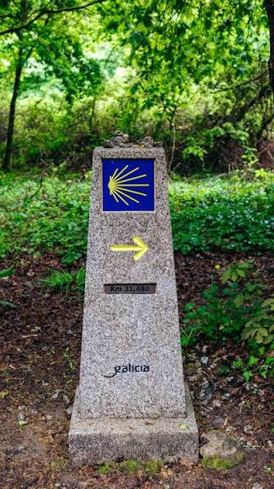
Yep. The signs made that happen. Let me just explain the stone monument. On the top is a yellow on blue scallop shell, modernized to look like the sun shining in a particular direction. The shell is part of the legend of St. James’ body washing up on the shores of Galicia covered with shells. Below it is the ever-important arrow. Not once did I wonder which way they were pointing, they placed these things very, very well. The black line actually is a piece of metal engraved with the kilometer marker of how far you had to go to the Cathedral in Santiago. It was most encouraging to watch those numbers decrease steadily. And at the bottom, it was signed by Galicia–the region (some might say country) Santiago is in.
The Apostle Paul said that we do not belong here on Earth, but that we are citizens of heaven (Phil 3:20). I kind of felt that way on the walk. I am a citizen of the United States. And I am just a wayfaring stranger in Spain. But the signs, all those signs, made me feel at home in Spain, or at least on the Camino. I am dependent on the signs.
And yeah, as Johnny Cash sang, I am just a “poor wayfaring stranger” in this world. Ultimately where we belong, as God’s children, is in a spiritual world, which is alluded to by some as “going over Jordan,” but is really a place where be belong. I’m continuously looking for signs on this side of Jordan, because someday, I’m going over there.
Still in Spain,
Craig
For we know that if the tent that is our earthly home is destroyed, we have a building
from God, a house not made with hands, eternal in the heavens. 2 Corinthians 5:1 (ESV)

